
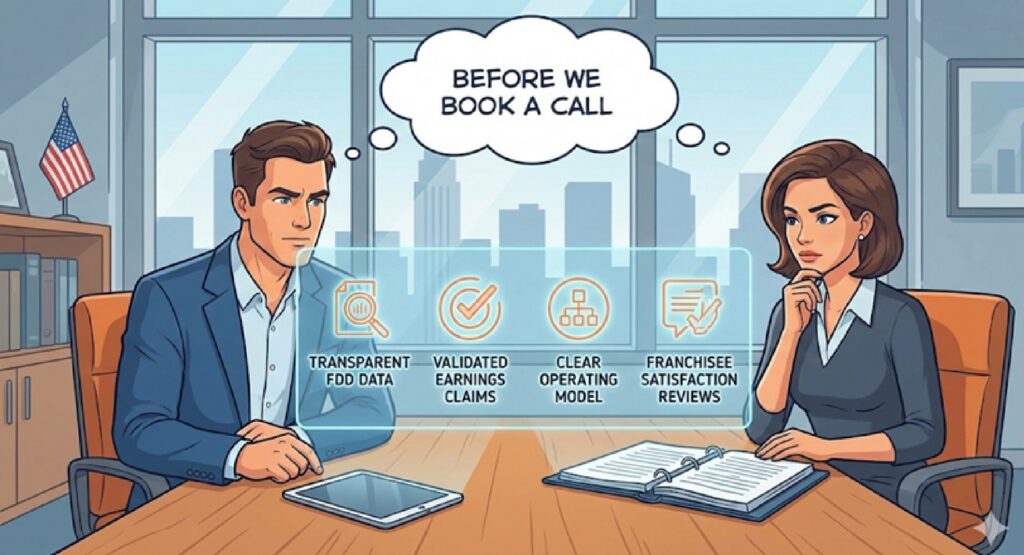
What Serious Franchise Owners Expect Before They Ever Book a Call
If you’re a VP of Marketing, CMO, or franchise development leader, you don’t book calls because someone asked nicely. You book calls because their online footprint proves they “get it.” In 2026, that vetting happens fast, mostly without a sales rep, and it’s ruthless. Buyers increasingly prefer to do independent research before talking to anyone.
That’s why a strong franchise digital marketing strategy is not a deck or a buzzword. It’s what shows up (and what doesn’t) when a serious franchisor checks Google, scans your locations, reads reviews, and looks for signals that you can scale across markets without breaking brand consistency.
Below is the checklist most serious franchise owners mentally run before they ever hit “Schedule.”
The “pre-call filter” happens on Google, not in your inbox
Before a decision-maker replies, they usually do three things:
- They search your brand and a couple of core services in a target market.
- They evaluate credibility in 60 seconds. That means reviews, local presence, and whether the site feels trustworthy.
- They look for proof you can operate across multiple locations, not just one.
This matters because local intent is high-intent. Google reports that 76% of people who conduct a local search on a smartphone visit a business within 24 hours, and 28% of those searches result in a purchase.
What “serious” looks like: 7 expectations that separate pros from pretenders:
1) You understand the unit economics behind leads
Serious owners don’t want “more leads.” They want qualified leads at a cost that makes sense for a unit-level P&L.
What they expect you to talk about:
Cost per lead targets by service line
Close rate ranges (even if you’re using conservative assumptions)
Lead-to-booked-job plumbing (tracking, attribution, call handling)
If a franchise marketing agency can’t explain how lead quality changes by market, season, and service mix, that call usually never happens.
2) You can balance brand control with local flexibility
Franchises are two realities at once: corporate brand consistency and local market truth.
A serious buyer looks for evidence you can:
Keep messaging on-brand
Enable local pages and location-specific offers
Protect the brand while letting units win locally
This is where franchise brand marketing becomes operational, not theoretical.
3) Your measurement is clean and honest
Good decision-makers don’t trust vanity dashboards. They want tracking they can audit.
They expect clarity on:
What counts as a lead (calls, forms, chats, booked jobs)
How duplicates are handled
How tracking works across web forms, call tracking, and ads
If reporting is fuzzy, franchise lead generation services sound like a gamble.
4) You respond like you respect money
Speed-to-lead is marketing, not just sales ops. InsideSales found conversion rates jump when follow-up happens in the first five minutes, yet only a tiny fraction of inbound leads get that treatment.
A serious franchisor will ask, “What happens after the lead comes in?” because they know wasted leads look like “marketing didn’t work.”
5) Your SEO is built for scale
Franchise SEO is not one website. It’s a system: location pages, service pages, reviews, internal linking, and content that matches real queries.
A strong franchise digital marketing strategy includes:
Location pages that are genuinely local (not copy-paste)
Service pages that match intent (not vague category pages)
Review strategy tied to trust, not just star counts
Technical hygiene so Google can crawl and understand the site
6) Your paid media plan doesn’t cannibalize organic
Paid search and SEO should reinforce each other. Serious owners expect you to know:
Which keywords to buy vs. earn
How to prevent brand campaigns from inflating performance
How to segment by location, service, and lead value
That’s the difference between “running ads” and operating like a franchise marketing agency built for multi-unit reality.
7) You have a real nurture plan (email and beyond)
Franchise buyers know most leads are not ready today. They expect lifecycle thinking: capture, qualify, nurture, and reactivate.
Email is often the quiet multiplier:
Automated follow-up sequences
Seasonal service reminders
Reactivation campaigns for past customers
Franchisee recruitment drips (when applicable)
That’s where franchise development marketing and lifecycle marketing intersect.
Two real-world examples (composite scenarios) that match what franchisors see:
Example A: 18-unit home services brand with scattered local visibility
Problem: Rankings were inconsistent across markets, and paid leads looked expensive.
Fix: Tightened location pages, improved review velocity, cleaned up tracking, and rebuilt paid search around high-intent service terms by market.
Result pattern you should expect: lower wasted spend, clearer CPL targets per service, and a more stable pipeline because organic and paid stop fighting each other.
Example B: 40-unit QSR brand with strong brand but weak local conversion
Problem: Good awareness, but local pages weren’t converting and units complained “marketing isn’t working.”
Fix: Upgraded local landing pages, improved offer clarity, and added simple email reactivation tied to store-level promotions.
Result pattern you should expect: better conversion rate on location traffic and measurable lift from repeat customers, not just new leads.
A short “pre-call” checklist you can use internally:
Before you ask someone to book time, make sure you can answer:
What does success look like at corporate level vs. unit level?
How will you track leads end-to-end, including calls?
What will you change in the first 30 days, and why?
How will you protect brand while improving local performance?
What does your PPC structure look like across markets?
FAQs: What Serious Franchise Owners Expect Before They Ever Book a Call:
Q1) What’s the first thing a franchisor checks before booking a call?
Usually Google results in a few target markets. They look for local visibility, credibility signals (reviews, brand consistency), and whether the website feels built for multiple locations.
Q2) How do I know if an agency understands franchise complexity?
Ask how they handle location-level reporting, brand consistency, and market-by-market strategy. If they can’t explain segmentation by location and service line, they’re likely treating you like a single-location business.
Q3) What’s a realistic timeline to see results from SEO and paid media?
Paid media can drive leads quickly once tracking and campaigns are structured correctly. SEO typically compounds over time, and meaningful momentum often takes a few months, especially for competitive markets.
Q4) What should be in a franchise-ready reporting dashboard?
At minimum: leads by source (calls/forms), CPL by location and service, conversion rate, and trend lines over time. It should also clarify what counts as a lead and how duplicates are handled.
Final Thoughts:
Serious franchise owners don’t book calls based on promises. They book calls when the proof is already visible: clear positioning, clean tracking, local performance signals, and a plan that scales across units. If your goal is predictable growth, treat your marketing like infrastructure and partner with franchise lead generation services that can defend every metric and decision.