
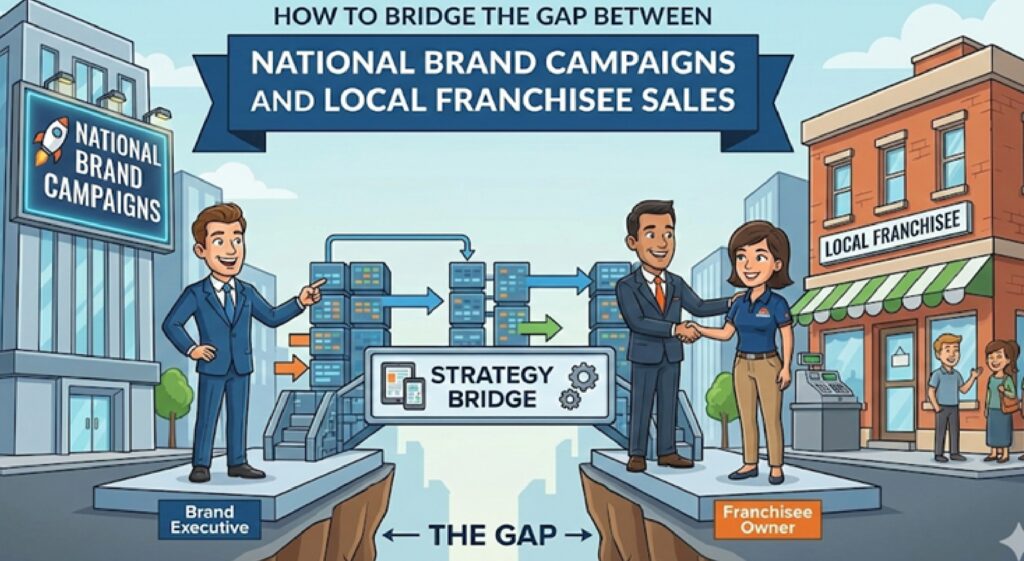
How to Bridge the Gap Between National Brand Campaigns and Local Franchisee Sales
National campaigns are effective at creating demand. But if your local pages, listings, and follow-up systems are weak, that demand leaks out fast, and your franchisees feel it first. The real challenge is turning brand awareness into booked calls, store visits, and closed deals in every territory. That’s where franchisee lead generation becomes a shared system, not a one-off tactic: corporate drives consistent message and assets, and local teams convert that intent into action with the right local setup and response workflow.
The good news is the “national to local” gap is fixable. You just need a repeatable way to translate brand energy into local proof, local relevance, and local conversion.
Why National Campaigns Don’t Automatically Create Local Sales:
National ads can spike branded searches and “near me” behavior. Google has reported that 76% of people who search on a smartphone for something nearby visit a business within a day, and 28% of those searches result in a purchase.
So why do local franchisees still say, “We’re not seeing sales”?
Because local conversion happens in a different arena than national awareness:
Local search results are crowded and decisive. A big share of local-intent clicks go to the map pack.
Trust is local. Reviews, photos, service area clarity, and response speed are what turn interest into revenue.
The customer journey is fragmented. A prospect may see a national ad, then Google the brand plus their city, then compare two or three nearby options in minutes.
If the brand campaign is the spark, local infrastructure is the engine.
The Bridge: A Simple National-to-Local System That Scales:
Think of the bridge as three connected layers: visibility, conversion, and follow-up.
1) Visibility: Win the “brand + city” moment
When a national campaign hits, people do not just search your brand. They search “brand + [city]” and “best [service] near me.” The local must-haves:
A consistent, location-first site structure (one strong page per territory, not thin duplicates)
Clean Google Business Profile governance (accurate categories, services, service areas, hours, and photos)
Local relevance signals (city-specific FAQs, service proof, neighborhood landmarks, and real job stories)
BrightLocal cites research showing 72% of consumers use Google to search for local business information. That makes Google your main “handoff point” between corporate demand and local conversion.
2) Conversion: Make every local landing page feel “made for me”
A national creative theme should stay consistent, but local pages must answer local questions fast:
What areas do you serve?
Do you have proof you’ve done this job in my city?
How quickly can you respond?
Can I get a clear next step right now?
This is where a franchise digital marketing agency earns its keep: not by making prettier pages, but by building local pages that convert in every market without losing brand consistency.
3) Follow-up: Turn leads into revenue with speed and structure
Most franchise systems underestimate what happens after the form fill or phone call.
Build a simple lead operating rhythm:
Immediate response standard: under 5 minutes for form leads during business hours whenever possible
Call tracking + source clarity: know whether the lead came from national, local SEO, PPC, or referrals
Email + SMS nurture: a short sequence that confirms appointment details, shares proof, and reduces no-shows
Email marketing matters here because it protects the sale you already paid for. It also gives corporate visibility into what actually converts locally.
Where SEO, PPC, and “Local Services” Fit (Without Fighting Each Other):
A high-performing franchise program uses channels for what they’re best at.
SEO: Capture intent you didn’t have to pay for
Local SEO is the compounding asset. Your goal is to be the obvious choice when someone is ready.
Build a “location page blueprint” that every franchisee can follow
Standardize citation management and NAP consistency
Make reviews a system, not a suggestion
PPC: Control timing, geography, and offer
Google Ads is your demand-capture lever when you need predictable volume, especially in seasonal spikes.
Separate brand vs non-brand campaigns
Use geo-tight targeting by territory
Match the ad offer to local service realities (availability, response times, financing, etc.)
Local Services Ads: High-intent leads for service franchises
For home services and similar categories, franchise Local Services can be a major bridge between “I’m interested” and “I need someone now,” because these placements often show up when intent is strongest.
The operational requirement is non-negotiable: you must respond fast, track outcomes, and protect lead quality with tight service area settings and strong review velocity.
Two Examples of Bridging National to Local (What It Looks Like in Practice):
Example 1: Restoration-style service brand
A national campaign drives a surge in searches, but local locations see uneven results. The fix usually includes:
A standardized service-page framework per territory (water, fire, mold, etc.)
Google Business Profile cleanup and consistent service lists
A tighter connection between ad messaging and local landing pages
A short follow-up sequence for estimates and bookings
This is exactly the type of program a franchise marketing agency for restoration brands should run: consistent brand voice, local proof, and clean measurement from lead to booked job.
Example 2: Retail or fitness franchise
National promos drive interest, but local conversion dips because prospects cannot quickly confirm local pricing, schedules, or availability. Improvements often come from:
Localized “promo landing pages” that preserve brand design but add local specifics
Store-level FAQs and real images
Email reminders and offer deadlines to increase show rate
How FetchaSquad Thinks About This Gap (Without the Fluff):
A national to local marketing agency for franchises should do three things well:
- Build a local conversion foundation (pages, listings, tracking)
- Scale lead capture across markets (SEO + PPC + nurture)
- Prove impact with simple reporting that franchisees actually trust
FAQs:
Q1) What’s the fastest way to improve local sales when a national campaign launches?
Tighten the local handoff: update location pages, confirm Google Business Profile accuracy, and ensure calls/forms route correctly with tracking. Then set a response-time standard so leads don’t go cold.
Q2) How do we keep brand consistency while letting franchisees localize?
Create a locked brand template (design, tone, core offers) and allow controlled local modules (service area, local proof, staff photos, FAQs, reviews, and local promotions).
Q3) Should we prioritize SEO or PPC to bridge the gap?
Do both, but sequence matters: fix the local foundation first (so clicks convert), then use PPC to capture demand while SEO compounds over time.
Q4) What metrics best reveal the “national to local” gap?
Look at brand search volume vs local conversions, map pack visibility, call answer rate, lead-to-appointment rate, and appointment-to-sale rate. If brand interest rises but those local metrics stay flat, the bridge is broken.
Final Thoughts:
Bridging national campaigns to local revenue is not a creative problem. It’s an execution problem that needs a system. When your pages, listings, ads, and follow-up work together, franchisee lead generation becomes predictable, measurable, and scalable across every market.