
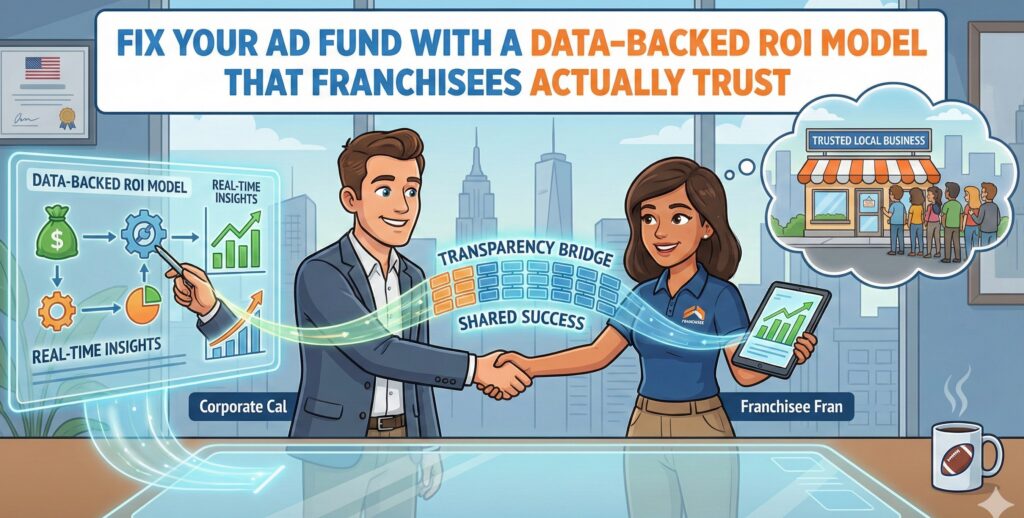
Fix Your Ad Fund With a Data-Backed ROI Model That Franchisees Actually Trust
If you lead marketing for a franchise system, you’ve felt it: franchisees want proof, not promises. They’re paying into an ad fund, costs keep rising, and everyone’s inbox is full of “marketing reports” that show clicks but not outcomes.
The fastest way to stop the debates is to stop guessing. A simple, data-backed ROI model turns messy channel performance into a clear story about what worked, what didn’t, and what to do next. Done right, it becomes the backbone of your franchise marketing strategies and makes budget conversations easier, calmer, and faster.
Why ad funds get questioned (and what franchisees really want):
Ad-fund tension rarely comes from “too little marketing.” It comes from unclear cause-and-effect.
Most franchisees are asking three practical questions:
- Where did the money go (by channel, market, and purpose)?
- What did we get back (leads, calls, bookings, revenue)?
- What will you change next month based on the data?
Finance and franchise ops care about risk, too. Both BDO and GBQ point out that transparency and clean reporting reduce conflict and even litigation risk around cooperative ad funds.
So your ROI model is not just a marketing tool. It’s governance.
The ROI model that works for franchising:
You don’t need a complicated dashboard to prove ROI. You need consistent inputs and definitions.
1) Spend (by channel and by intent)
Break spend into buckets franchisees understand:
Demand capture (high intent search)
Demand creation (awareness, video, discovery)
Retention and reactivation (email and SMS)
Local visibility (GBP, reviews, local SEO)
2) Leads you can defend
Track leads by type, not just total volume:
Calls over X seconds
Form fills that include service + location
Chats that convert to appointments
Store visits (when valid and measurable)
3) Close-rate assumptions (by lead type)
A lead is not a lead is not a lead. Calls from high-intent searches usually close higher than broad awareness traffic. Your model should include close rates by lead category, even if they start as estimates that you refine each month.
4) Average order value (AOV) and gross margin
ROI should be based on profit, not revenue, whenever possible. If you can’t get margin by location, use a conservative blended margin and document it.
5) Customer value beyond the first purchase
For many franchises, email and SEO shine over time. A simple “first job profit” ROI is fine for monthly reporting, but you should also track repeat rate or 90-day value so you don’t accidentally underfund channels that compound.
Two guardrails that prevent bad decisions
Attribution rules: define how you count multi-touch leads (first-touch, last-touch, or blended).
Quality thresholds: agree on what counts as a “qualified” lead across the system.
Where SEO, PPC, lead gen, and email fit in one scoreboard:
A unified ROI model lets each channel do its real job.
SEO: the compounding asset that lowers long-term acquisition cost
Local SEO and Google Business Profile work because franchise customers search close to the moment of need. In local search behavior studies, Google Search and Google Maps are consistently top tools for finding local businesses.
SEO’s role in the ROI model is to increase qualified demand capture while reducing reliance on paid clicks over time.
What to measure:
Local pack visibility by market
Non-brand organic calls and forms
Service-page rankings tied to revenue services (not vanity keywords)
Google Ads / PPC: the controllable lever for predictable lead flow
Google’s own economic impact methodology cites an estimate that advertisers average $2 in revenue for every $1 spent on Google Ads, and uses that in broader calculations about advertiser value.
In franchising, PPC works best when you treat it like an operating system:
Tight keyword-to-landing-page match
Location-level call tracking
Offline conversion import (booked jobs, not just leads)
Email marketing: the ROI multiplier most brands under-measure
Email is still one of the highest ROI channels when it’s run with discipline. Litmus reports an average ROI of $36 for every $1 spent.
But many teams still don’t measure it consistently. In Litmus’ reporting, 21% of marketing leaders don’t measure email ROI.
For franchises, email also smooths out seasonality by turning “not yet” leads into booked work later.
What to measure:
Lead-to-customer conversion from nurture sequences
Reactivation revenue (past customers)
Review generation impact (which feeds local SEO)
A practical 30-day rollout plan (without boiling the ocean)
Here’s a realistic way to implement the model fast:
Week 1: Standardize tracking
Confirm call tracking, form tracking, UTMs, and a single “source of truth” for lead counts.
Week 2: Define “qualified lead” and close stages
Agree on lead categories and what counts as booked, completed, and repeat.
Week 3: Build the ROI worksheet
One page per location plus a roll-up view: Spend → Qualified Leads → Bookings → Profit → ROI.
Week 4: Publish the “Proof Pack”
A short monthly update: where dollars went, what came out, and one decision you made because of the data.
This is also where a strong franchise digital marketing agency earns its keep: not by sending prettier reports, but by making the numbers trustworthy and repeatable.
Three examples of ROI clarity in the real world:
These are composite examples based on common patterns across multi-location brands.
Home services (25 locations): “Stop paying for junk calls.”
The system added call quality filters (duration + intent) and imported booked jobs back into ad platforms. Reported ROI jumped, even before performance improved, because “leads” finally matched reality.
QSR (60 locations): “Email turned ads into repeat customers.”
Paid search brought first orders, but email offers and loyalty reminders lifted 30-day repeat revenue. The ad fund got less pushback because the ROI model showed total profit, not first-click metrics. Email ROI benchmarks support why this channel can carry outsized returns when measured properly.
Emerging brand (12 locations): “Marketing that supports growth.”
When leadership aligned local lead gen with franchise recruitment goals, the team built content and campaigns that supported expansion messaging too. That’s especially useful for franchise development companies that need steady, qualified pipeline, not random form fills.
How to pick a partner without losing control:
If you’re evaluating a franchise digital marketing agency for franchisors, ask one simple question:
“Will you help us prove ROI in a way franchisees will accept?”
Look for a partner that:
Sets measurement rules before launching campaigns
Reports on qualified leads and booked outcomes
Can explain performance in plain English to ops and franchisees
FAQs:
Q1) What’s the biggest mistake brands make when reporting ad-fund ROI?
Counting “leads” without defining quality. If you don’t separate real opportunities from junk, the ROI conversation will never settle.
Q2) How do we handle attribution when customers touch multiple channels?
Pick a rule and stick to it for at least a quarter (last-touch, first-touch, or blended). Consistency matters more than perfection early on.
Q3) What if franchisees don’t share sales or close-rate data?
Start with booked appointments or completed jobs as the “conversion,” then improve the model over time. Even partial downstream data beats clicks-only reporting.
Q4) How often should we update the ROI model?
Monthly for ad-fund communication, weekly for internal optimization. Monthly keeps franchisees informed, weekly keeps performance improving.
Final Thoughts:
Ad funds don’t fail because marketing “doesn’t work.” They fail because ROI is unclear. A simple, consistent model gives you the proof you need to defend spend, improve performance, and scale smarter. When your franchise marketing strategies are tied to outcomes franchisees care about, the conversation shifts from complaints to momentum.