
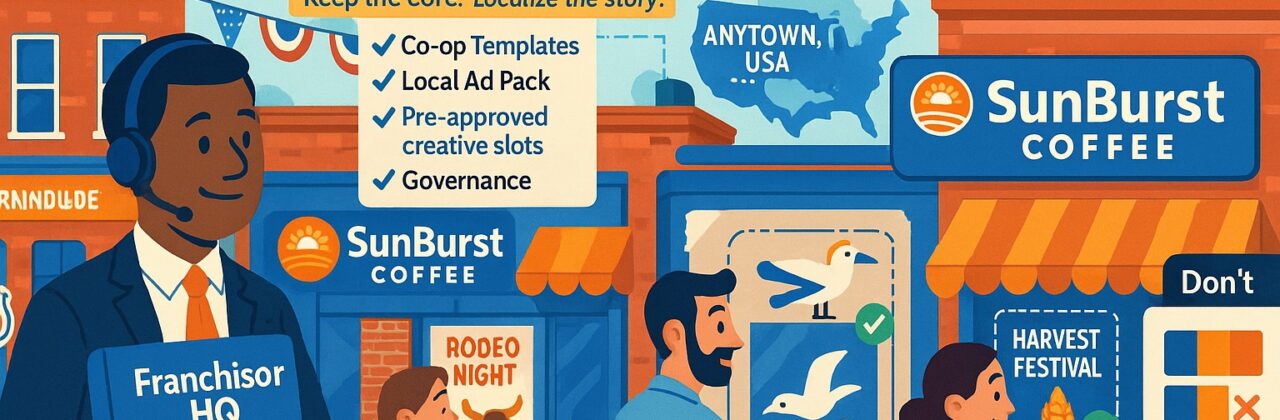
Brand Consistency Without Killing Local Creativity: How to Prevent Franchisee Pushback
For most marketing leaders in franchising, “brand standards” can feel like a double-edged sword. On one side, you need a recognizable, consistent brand that scales. On the other, your franchisees live in real local markets that demand nuance, personality, and speed. No surprise that this tension often shows up as pushback, quiet resistance, or rogue marketing.
Consumers are not helping your cause. Around 71% of customers expect a consistent experience across channels, yet only 29% say brands actually deliver it. That means your next promotion, landing page, or Google Ads campaign has to thread a very tight needle. This is where a strong operating model, supported by the right franchise marketing agency, becomes a strategic advantage rather than “more rules from corporate.”
Why Brand Consistency vs Local Creativity Breaks Down:
Pushback rarely happens because franchisees “don’t care about the brand.” It usually comes from three very practical pain points:
The national calendar does not match local seasonality or realities.
Creative assets feel generic and disconnected from local culture.
Local owners do not see clear performance data that proves the rules are working.
Meanwhile, customers are searching locally first. Four in five consumers use search engines to find local information, and more than three quarters visit a local business within five miles after a local search.If your locations are inconsistent on Google, social, and landing pages, your brand promise breaks at the exact moment it matters most.
The goal is not to choose between control and creativity, but to design a system where both can win.
The Digital Front Line: Where Pushback Shows Up First:
SEO & Local Search: Central Guardrails, Local Flavor
Local search is often the first place franchisees freelance their marketing. One location updates its Google Business Profile weekly, another ignores it, and a third changes the brand name slightly to “feel more local.”
A smarter approach:
Corporate defines non-negotiables for naming, categories, logo, review responses, and core service pages.
Locations get structured flexibility for local photos, community highlights, and service emphasis (for example, coastal vs inland, urban vs suburban).
A central or external franchise digital marketing agency manages multi-location SEO, technical health, and content templates, while franchisees plug in local details.
This is where a franchise digital marketing agency for franchisors can quietly do a lot of heavy lifting: tracking rankings across markets, standardizing on-page structure, and identifying which local tweaks actually move the needle.
When 46% of Google searches are for local information and four in five consumers say they prefer ads tailored to their location, you cannot afford one-size-fits-all local visibility.
PPC & Paid Social: One Strategy, Many Local Offers
Paid media is often where the loudest arguments happen. Franchisees want “their own” campaigns; corporate wants control of spend and messaging.
A workable model:
Corporate owns the account structure, pixel strategy, conversion tracking, and brand-safe ad templates.
Franchisees select from pre-approved offer frameworks (for example: free add-on, seasonal discount, bundle), then localize copy for their market within defined character and brand guidelines.
A central media team or specialized franchise marketing agency manages bidding, negative keywords, and budget allocation by performance.
This lets franchisees feel like they are driving demand locally without compromising efficiency, data integrity, or brand voice.
Email & CRM: Shared Calendar, Local Stories
Email is still one of the most efficient channels for both lead nurturing and franchise development. The friction appears when every location wants its own newsletter, tone, and schedule.
Instead, treat email like a shared infrastructure:
Corporate defines the master calendar (welcome flow, seasonal pushes, review-generation campaigns, reactivation).
All emails use standard layouts, headers, footers, and legal copy.
Local owners get “story blocks” to feature their team, local testimonials, or community events inside those templates.
A franchise digital marketing agency or internal CRM team can then test subject lines, send times, and content blocks at scale while still letting local stories shine.
A Framework To Reduce Franchisee Pushback:
- Draw the Line Between “Non-Negotiable” and “Flexible”
Most conflict comes from not knowing what is truly off-limits. Put it in writing:
Non-negotiables: logo usage, color palette, typography, brand promise, tone of voice, legal disclaimers, data tracking, core offer structure.
Flexible: local imagery, community partnerships, localized social content, local ad angles, service emphasis by region.
Review this with franchise advisory councils and your franchise development companies partners so everyone knows where creative energy is welcome.
- Co-Create Playbooks With Your Best Operators
Your highest-performing locations are already proving what works locally. Instead of handing them “brand police” documents, invite them into building the playbook:
Run a quarterly virtual workshop with top franchisees to review what campaigns worked and why.
Turn those into documented franchise marketing solutions: plug-and-play campaigns with proven copy, landing pages, and follow-up sequences.
Give attribution: when a campaign came from the field, say so. It increases buy-in across the network.
A franchise development marketing agency can help facilitate these sessions, structure the data, and turn them into repeatable systems for new markets.
- Offer Choice, Not Chaos
Franchisees resent “take it or leave it” campaigns. They respond much better to “choose one of these three options.”
For each major initiative (new product, seasonal push, recruitment drive):
Provide three creative angles that all meet brand standards.
Provide localizable assets (social posts, email copy, landing page sections) for each angle.
Make the opt-in process simple through your intranet, portal, or marketing platform.
This “choice architecture” gives local owners a sense of control while keeping campaigns aligned. A national to local marketing agency for franchises can help build this library and automate distribution.
- Use Data to Turn Skeptics Into Advocates
Nothing reduces pushback like transparent performance. When franchisees see that standardized campaigns produce better cost per lead or higher close rates, the conversation changes.
Consider:
Shared dashboards that show location-level SEO visibility, PPC performance, and lead sources.
Side-by-side comparisons of locations that follow the playbook vs those that do not.
Quarterly business reviews that focus on what local experiments worked and how they can be rolled out system-wide.
After partnering with a franchise digital marketing agency:
Corporate and a small group of top operators defined non-negotiables and a “flex zone” for local messaging.
A new search and PPC framework rolled out with consistent tracking and three pre-approved offer types per market.
Franchisees received a simple dashboard showing leads, cost per lead, and booked jobs, broken out by campaign type.
Within six months, locations that fully adopted the system saw double-digit lifts in lead volume and more efficient ad spend, while the perceived role of corporate shifted from “brand police” to “growth partner.”
FAQs: Brand Consistency & Local Creativity:
Q1. How much creative freedom should franchisees really have?
Franchisees should have full freedom inside a clearly defined “flex zone.” Corporate protects core elements like logo, brand promise, and key messages, while franchisees control local stories, community partnerships, and offer angles that fit their market.
Q2. What is the best way to handle franchisees who ignore brand standards?
Start with data, not discipline. Show how compliant campaigns perform vs non-compliant ones. If gaps remain, revisit your guidelines to make sure they are practical, then use coaching, clear consequences, and peer examples to bring locations back in line.
Q3. How can a franchise digital marketing agency help reduce pushback?
A specialized agency can centralize SEO, PPC, and email infrastructure, provide brand-safe templates, and then localize campaigns by market. They often act as an objective third party that translates corporate strategy into practical local execution franchisees trust.
Q4. Where should we start if our system is already fragmented?
Begin with one pilot: a small group of willing franchisees, one channel (often Google Search or paid social), and one clear goal, like lowering cost per lead. Prove that a more structured approach works there, then roll out the framework and lessons to the rest of the network.
Final Thoughts:
Preventing franchisee pushback is less about writing longer brand manuals and more about designing a system that respects local reality. Clear guardrails, co-created playbooks, and transparent data give local owners room to win without diluting your brand.
Whether you build internally or partner with a franchise marketing agency, the goal is the same: consistent, trusted experiences at scale, powered by authentic local stories.
About FetchaSquad:
FetchaSquad is the franchise development marketing agency trusted by Steamatic Corporate, helping franchise owners grow their local markets with proven, ROI-focused strategies. Since 2013, FetchaSquad has driven measurable growth for brands featured in The New York Times, Forbes, Wall Street Journal, Shark Tank, TechCrunch, and Entrepreneur. We build performance marketing systems that turn ad spend into revenue—specializing in multi-location brands where corporate strategy meets local execution. Our campaigns across Google Ads, SEO, and Meta don’t just generate leads; they fill pipelines with high-intent customers ready to buy. Whether you’re scaling nationwide or owning your territory, we deliver one thing: results that show up on your bottom line.